

You don’t have to trade curiosity for conscience. If you’ve been wondering how to plan a trip that feels epic and ethical, 2025 is the year to make it real. This carbon offset vacation planning 2025 guide is your friendly roadmap to traveling sustainably, without losing the joy, spontaneity, or the good coffee. You’ll set intentions, choose smarter routes, spend where it matters, and leave places better than you found them.
Set Your Intentions, Budget, And Pace (Slow Travel Wins)

Start with why. Is this trip about reconnecting with nature, deep-diving into a city’s food scene, or working remotely from somewhere sunny? Clear intentions shape a low-impact plan: fewer hops, more depth, less stress.
Slow travel isn’t a trend: it’s a carbon-smart reset. Fewer checkouts, longer stays, and train or bus segments instead of short flights can cut your footprint dramatically. You’ll also spend more with local businesses, the breakfast spot that remembers your name by day three.
Budgeting for sustainability means putting your money where your values are:
- Set aside 1–3% of your total trip cost for verified carbon offsets.
- Prioritize quality: pay a little more for a train pass, an eco-certified stay, or a nonstop flight.
- Plan for pace: longer stays often mean weekly discounts on lodging and fewer transport costs.
Choose Low-Carbon Destinations And Timing

Flight-Free And Short-Haul Ideas From The U.S.
If you can skip a plane, do it. From the U.S., you’ve got more options than you think:
- Northeast Corridor (DC–Philly–NYC–Boston): Amtrak, regional buses, and robust public transit. Stack museum days with park picnics, no rental car needed.
- Pacific Northwest (Portland–Seattle–Vancouver, BC): Amtrak Cascades and scenic bus routes: add island-hopping by ferry.
- Southwest desert loop: EV road trip from Phoenix to Sedona and Flagstaff: charge at hotels that offer Level 2 stations.
- Midwest city string: Chicago–Milwaukee–Madison by train/bus, bike-friendly cores.
- Caribbean and Mexico short-haul: If you fly, opt for nonstop to places building sustainable infrastructure (e.g., Playa del Carmen eco-tours: Puerto Rico’s community-led nature reserves). Further afield, destinations like Palawan, Philippines, and Chiang Mai, Thailand, are advancing low-impact lodging and transit, great if you’re combining a longer stay with remote work.
Shoulder Seasons And Overtourism Considerations
Timing matters. Travel in shoulder seasons, think April–May or late September–November in many regions, to reduce strain on local resources and dodge inflated prices. You’ll find fewer crowds in national parks after Labor Day, Venice outside summer, and U.S. mountain towns in spring and fall. It’s better for the environment and your sanity.
Smarter Transport Decisions
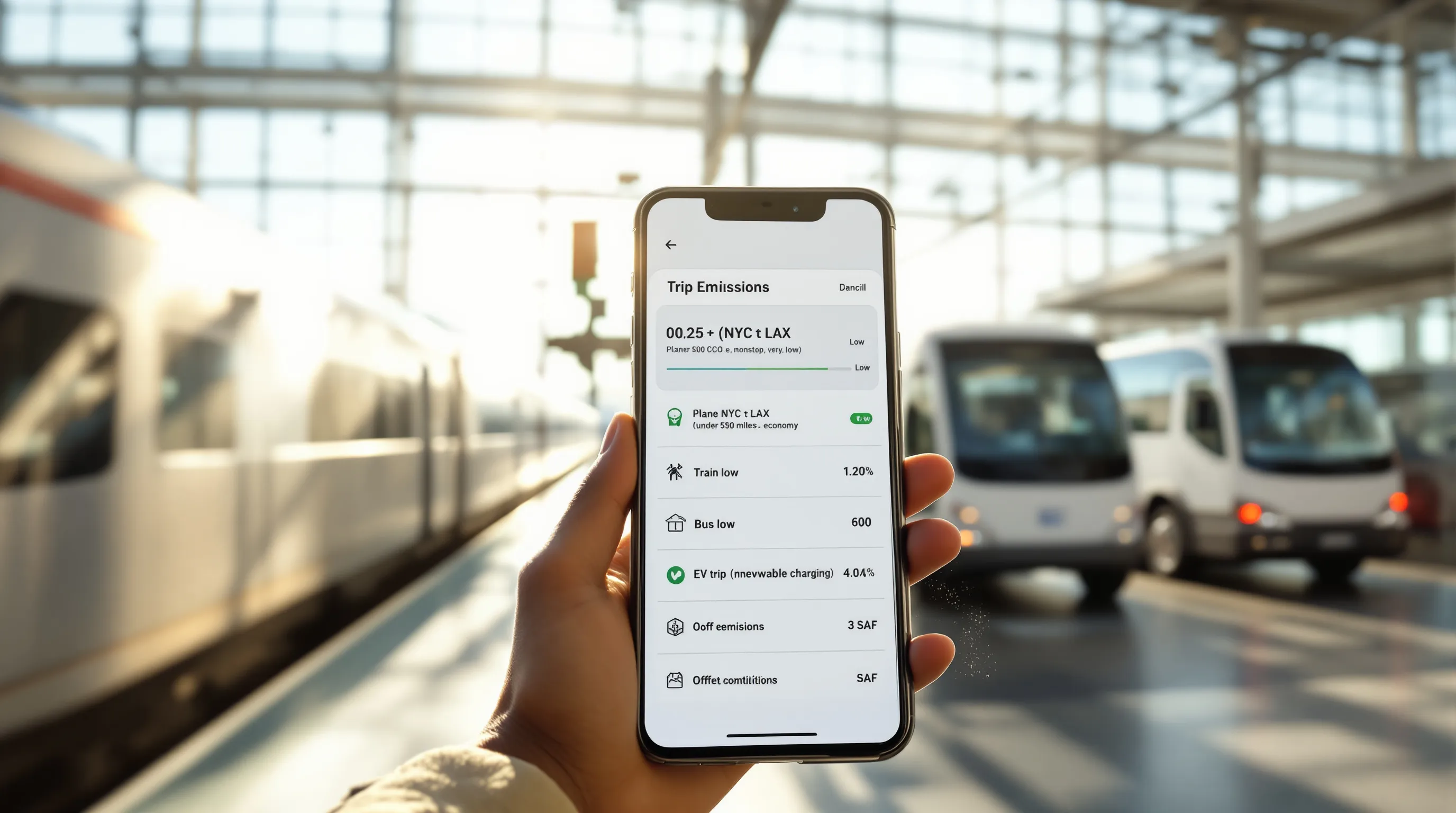
Compare Emissions: Plane Vs. Train Vs. EV Vs. Bus
- Trains: Typically the lowest-carbon per passenger for medium-distance trips, especially on busy corridors.
- Buses/Coaches: On par with trains in many cases: great for budget travelers.
- EV Road Trips: Low emissions if you charge with renewables or in regions with cleaner grids. Apps like PlugShare help you plan.
- Planes: Highest emissions per mile, especially short hops. Flying economy spreads the plane’s footprint across more seats: premium cabins can double or triple your per-person impact.
Rule of thumb: choose train or bus under ~500 miles when possible: if you must fly, make it count.
Book Flights Better: Nonstops, Economy, Newer Aircraft
- Nonstop flights cut fuel-hungry takeoffs/landings and total miles.
- Economy seats usually mean a significantly lower per-passenger footprint.
- Pick fuel-efficient aircraft when you can (Boeing 787, Airbus A350/A321neo). Google Flights shows estimated emissions and sometimes aircraft type.
- Consider airlines offering sustainable aviation fuel (SAF) contributions at checkout, helpful, though still scaling.
A rough sense of impact: a round-trip economy flight NYC–LAX can emit ~0.6–0.9 metric tons CO2e per person: NYC–London can be ~1.0–1.6 t CO2e. Use these to plan your offsets and route choices.
On-Trip Mobility: Public Transit, Bikes, And Walking
Design your days around low-carbon moves:
- Buy city transit passes (e.g., Oyster in London, MetroCard equivalents, or contactless payments).
- Grab a bike share (Citi Bike, BIKETOWN, Santander Cycles) and ride river paths and protected lanes.
- Walkable neighborhoods > cross-town Ubers. If rideshares are necessary, choose pooled or EV options where available.
Sleep, Eat, And Explore With Local Impact
Lodging That Minimizes Footprint
Look for clear sustainability practices, not vague slogans. Good signals:
- Certifications: Green Key, EarthCheck, LEED, B Corp.
- Energy and water transparency: heat pumps, solar, linen reuse, low-flow fixtures.
- EV charging and public transit proximity.
- Locally owned or community-based stays that reinvest in the neighborhood.
Bonus move: stay longer (4–7 nights) to reduce cleaning cycles and transit emissions.
Food Choices And Local Experiences
- Go local and seasonal: farmers’ markets, family-run eateries, and regional dishes.
- Try plant-forward meals a few times a week: skipping a couple meat-heavy meals per trip meaningfully trims your footprint.
- Book small-group tours led by locals, street food walks, cooking classes, urban foraging, so your dollars stay put.
Approximate costs to expect: $50–$120 for a quality food tour, $15–$30 for a market-to-table lunch, and $5–$20 for city transit day passes.
Respectful Wildlife And Nature Activities
- No riding wild animals (elephants, big cats) or selfie shows.
- Choose sanctuaries with independent accreditation and clear welfare standards.
- Stick to marked trails, pack out trash, use reef-safe sunscreen, and keep a respectful distance from wildlife. The best shot is often the one you don’t force.
Carbon Offsets That Actually Count
What Offsetting Can And Cannot Do
Offsets help compensate for emissions by funding projects like reforestation, clean cookstoves, peatland restoration, or renewable energy. They don’t erase your footprint, and they’re not a free pass to overfly. Think of them as the last step, after you’ve reduced what you can.
How To Calculate Your Trip’s Footprint
Use trusted calculators to estimate your CO2e:
- ICAO Flight Calculator (industry-backed, simple route inputs)
- MyClimate or CoolClimate (more granular options)
- Google Flights emissions estimates (compare routes before booking)
- For road trips, input mileage and vehicle type: for EVs, consider grid mix (coal vs. renewables).
Choosing High-Quality Offsets In 2025
Look for third-party verification and transparency:
- Standards: Gold Standard, Verified Carbon Standard (Verra), American Carbon Registry.
- Project types with co-benefits: clean cookstoves (health + deforestation reductions), renewable energy in emerging markets, mangrove/peatland protection (high carbon density), and improved forest management with strong permanence safeguards.
- Read the project docs: additionality, monitoring, and community benefits should be clear and recent.
When To Buy And How Much To Budget
Buy after you finalize transport and lodging so your calculation is accurate. Typical prices range from about $8–$25 per ton CO2e for reputable projects. As a planning cue:
- U.S. cross-country round trip (economy): budget ~$15–$30 for offsets per person.
- Transatlantic round trip (economy): ~$25–$60 per person.
- Add a cushion for on-trip transport and lodging energy use (another $10–$25 on longer stays).
Tip: earmark 1–3% of your total trip budget for reductions (train, eco-stays) and offsets combined. Offsets are the finale, not the headline.
Pack Light, Tech-Savvy, And Ready To Reuse
Packing To Cut Emissions And Waste
Every pound matters in transit. Go carry-on when you can. Pack:
- Refillable bottle + filter cap (or collapsible bottle)
- Tote bag and packable daypack
- Compact cutlery set and reusable straw
- Shampoo/soap bars and a small leak-proof container for refills
- Quick-dry clothing in a coordinated color palette
- Portable charger and universal adapter
Light packing means fewer rideshares, easier train hops, and less temptation to impulse-buy single-use stuff.
Apps And Tools To Plan Sustainably
- Transit and planning: Citymapper, Google Maps (transit layers), Rome2Rio, Omio, Trainline
- Carbon and routes: Google Flights (emissions display), ICAO Calculator, MyClimate
- Food and waste: HappyCow (veg-friendly eats), Too Good To Go (food rescue)
- EV road trips: PlugShare, ChargePoint, Electrify America
- Connectivity: eSIM apps (Airalo, Holafly) to skip plastic SIMs and find Wi‑Fi fast
Keep confirmations in a notes app to avoid printing. Download offline maps so you can walk without data panic.